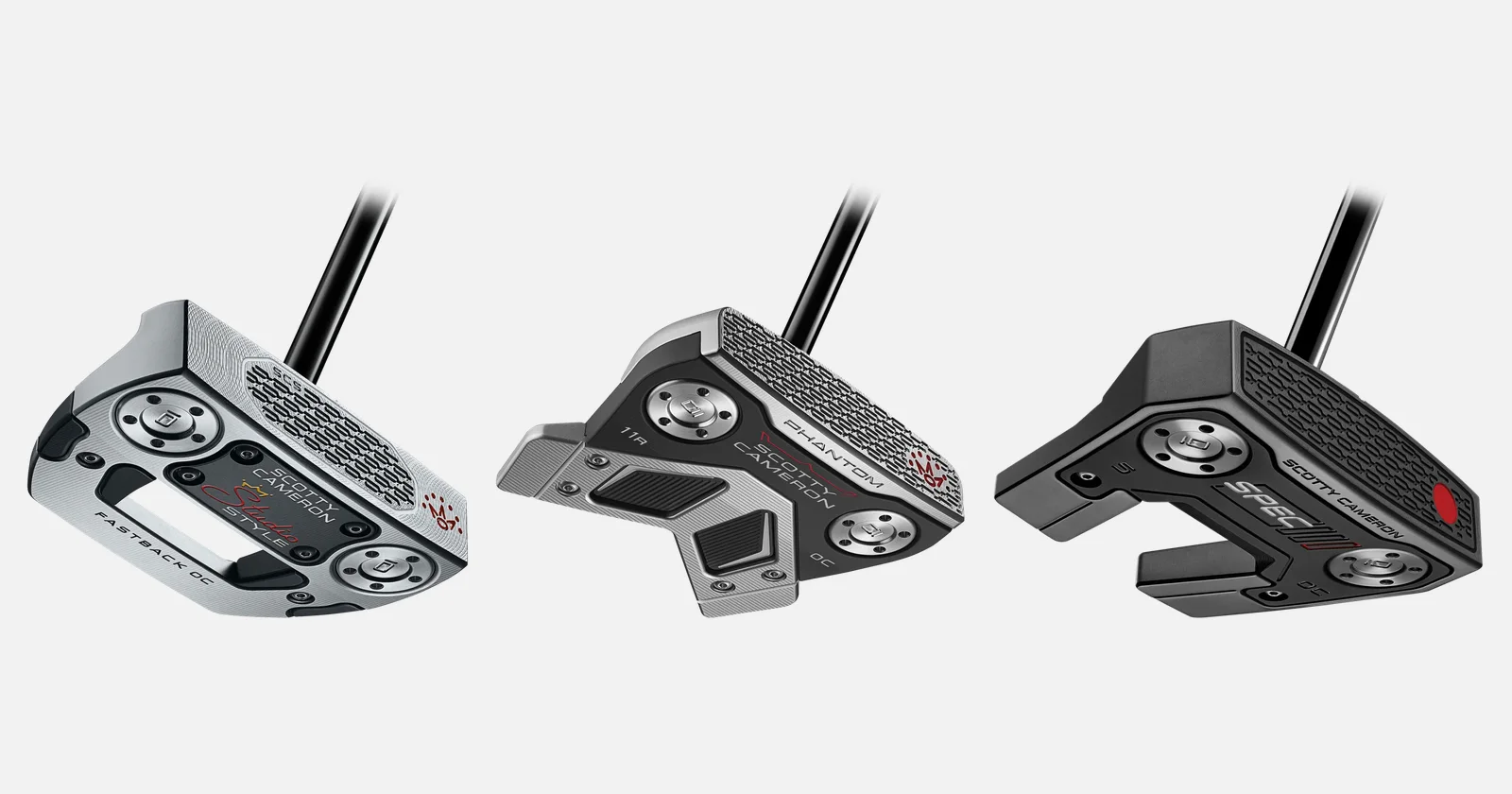
Low torque is a putter design approach that keeps the head from twisting around the shaft axis during the stroke, so the face can stay square to the path of the putter. Scotty Cameron calls its solution Onset Center (OC): a straight shaft that leans 1° forward and sits in line with the head’s center of gravity (CG). The brand currently has three models in its Low Torque collection — Phantom 5 OC, Phantom 11R OC and Studio Style Fastback OC — and all three are available at LionGolf.
In this article
- What is putter torque?
- What is Scotty Cameron’s Onset Center (OC)?
- Low torque vs Zero Torque
- The 3 Scotty Cameron low torque models
- Who should choose a low torque putter?
- Trying and fitting an OC putter at LionGolf
- Frequently asked questions
What is putter torque?
Torque is the tendency of the putter head to rotate around the shaft axis during the stroke. A putter with the shaft attached away from the center of gravity (plumbing neck, slant neck, jet neck…) lets the toe “flow” along the arc — Scotty Cameron calls this toe flow. That suits golfers who stroke the putter on an arc (slightly inside, square at impact, back inside).
A straight shaft, in contrast, gives minimum toe flow. According to the brand’s glossary, a straight shaft can help golfers who tend to manipulate the face with their hands; those strokes tend to start inside the ideal arc, with missed putts generally pulled. Low torque takes that idea further: the straight shaft is placed on the head’s center-of-gravity axis, and the head is made heavier to stay stable.
What is Scotty Cameron’s Onset Center (OC)?
“Onset” means the shaft is set back from the leading edge of the face. In the Onset Center configuration, the straight shaft is positioned in line with the head’s CG and leans 1° forward. According to Scotty Cameron, this gives a stable, low-torque putter whose face stays square to the stroke path throughout the stroke. The brand describes the OC technology package as “tour validated”.
| Component | Brand description | Role |
|---|---|---|
| Onset-center straight shaft | In line with the head’s CG, leaning 1° forward | Low torque; face stays square to the path |
| Heavier head | Higher overall weight, 2 × 10–20 g weights depending on length | Maximum stability while keeping torque very low |
| Black KBS x Scotty Cameron shaft | Flex chosen specifically for the OC line | Stability, unimpeded alignment, precise feel |
| Mid-size 11-inch Matador grip | Black with a debossed chain-link texture | Comfortable hands, a steady stroke |
| Chain-link face milling | Reduces touch points between face and ball | Softer sound, better roll, preserved feel and feedback |
Low torque vs Zero Torque
Both aim to limit unwanted face rotation, but they get there differently. Scotty Cameron’s low torque (OC) uses a straight shaft in line with the CG, a 1° forward lean and a heavier head; the brand describes torque as “low”, and the Fastback OC page lists Low Torque as “Minimum”. Zero Torque is a technology that balances the putter at its lie angle so the face has no tendency to rotate — see What is Zero Torque? for a detailed comparison and the Zero Torque putters at LionGolf.
The 3 Scotty Cameron low torque models
The three models below share the OC package: 3.5° loft (plus 1° shaft lean), 70° lie, 33″, 34″ or 35″ length, weights of 2 × 20 g (33″), 2 × 15 g (34″) and 2 × 10 g (35″), and a 303 stainless steel body (the two Phantom models add a 6061 aluminum sole/flange).
| Model | Head shape | Highlights |
|---|---|---|
| Phantom 5 OC | Compact winged mallet | Deeper face, subtly rounded contours, full-face Studio Carbon Steel insert |
| Phantom 11R OC | Rounded mallet (“R” = round) | Inspired by prototypes made for tour players; heavy head, high stability |
| Studio Style Fastback OC | Mid-mallet | Ring-weighted, high-alignment, multi-material design, Studio Carbon Steel insert |
Phantom 5 OC
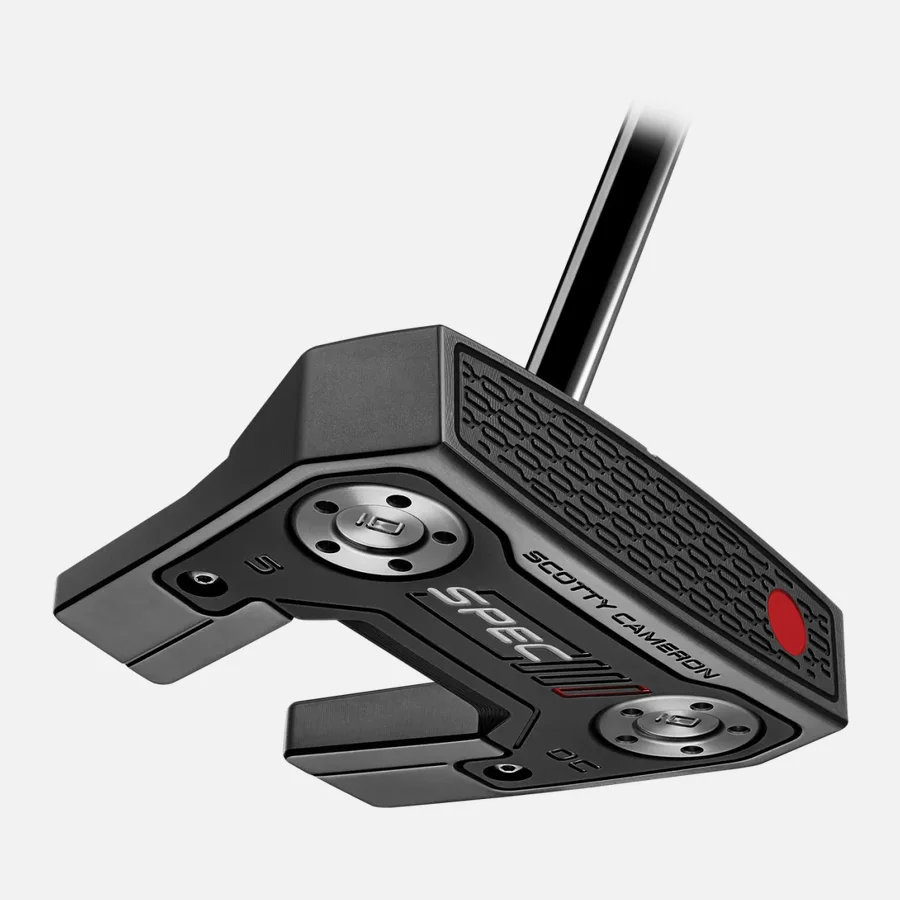
The Phantom 5 OC keeps the compact winged mallet shape of the Phantom family, with a deeper face, subtly rounded contours and a full-face Studio Carbon Steel insert with a chain-link pattern for softer sound and feel. The brand positions it for golfers who want a simplified stroke with the face square to the path. LionGolf carries the Phantom 5 OC Spec III — a limited edition finished in black from grip to sole, with three high-contrast sight lines. If you prefer a traditional offset shaft, the Phantom 5 (mid single-bend) is also on the LionGolf website.
Phantom 11R OC
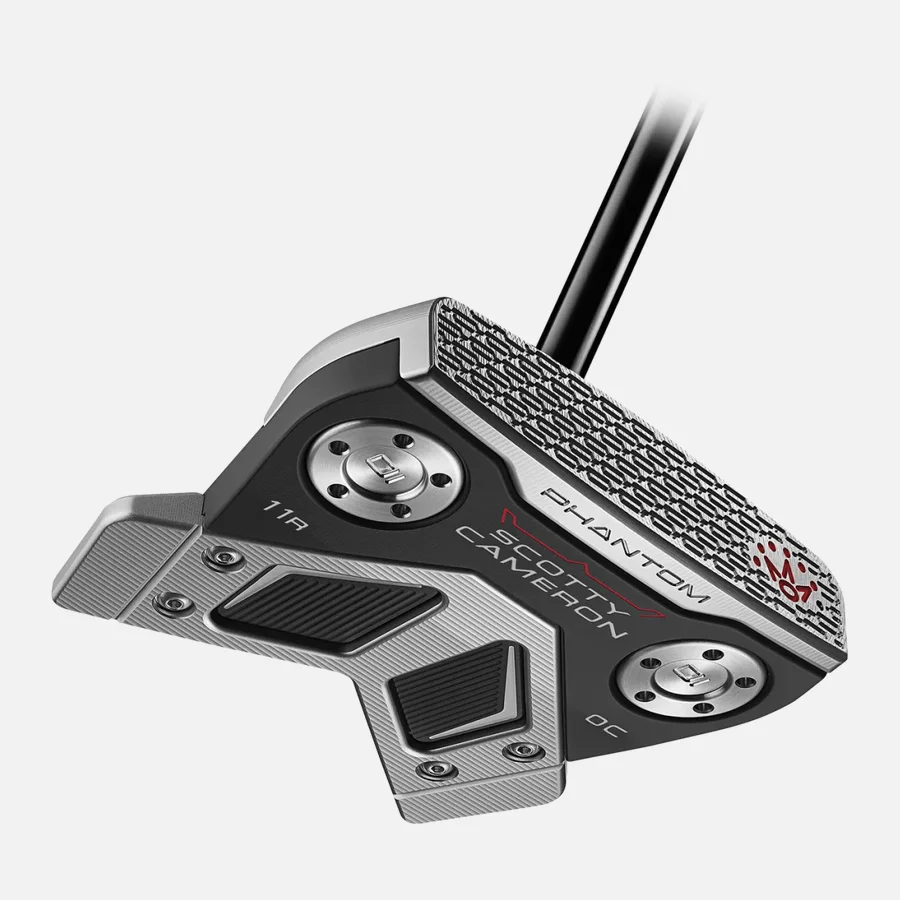
The Phantom 11R OC takes its inspiration from prototype models made for tour players, with rounded corners. A heavier head provides maximum stability while keeping torque very low through the stroke. With a 1° shaft lean, strong alignment cues and a familiar setup, it is the one for golfers who like a large, stable mallet. See the Phantom 11R OC or the Phantom 11R OC Spec III at LionGolf.
Studio Style Fastback OC
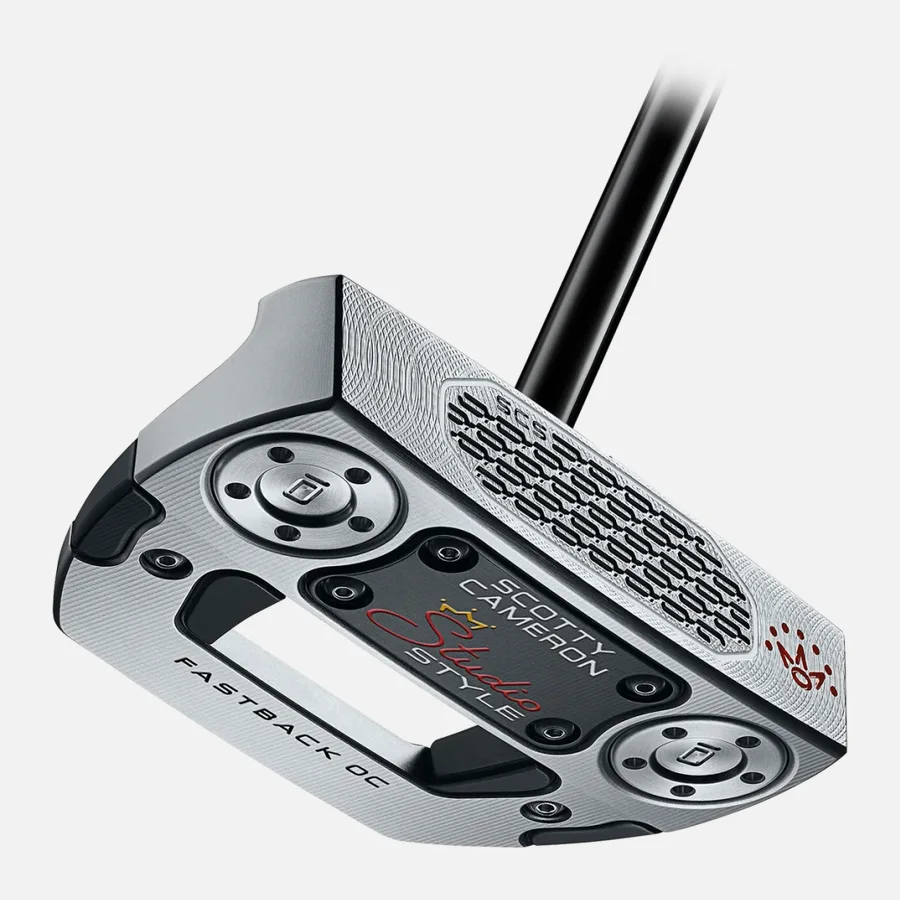
The Fastback OC extends the popular Studio Style Fastback design: it keeps the ring-weighted, high-alignment, multi-material construction and adds the OC package. The shaft sits onset center behind the leading edge of the face, in line with the CG and leaning 1° forward. The chain-link-milled Studio Carbon Steel (SCS) insert delivers soft sound and feel and the roll that tour players prefer, while the black anodized aluminum heel-toe inlay aids alignment and adds weight. See the Studio Style Fastback OC.
Who should choose a low torque putter?
According to the brand, the OC line is for golfers who want a simplified stroke with the face square to the path. In practice, a low torque putter is worth trying if you:
- Stroke the putter almost straight back and straight through, with little arc.
- Tend to rotate the face with your hands or wrists and often miss to the left.
- Want a more stable head on off-center strikes or under pressure.
- Prefer a mallet or mid-mallet to a blade.
If you stroke with a clear arc and are used to a lot of toe flow (plumbing or slant necks), a straight-shaft putter may feel different at first — try it in person before deciding.
Trying and fitting an OC putter at LionGolf
Choosing a low torque putter is about more than head shape. Length, lie, loft and weight all affect whether the face is really square at impact. According to Scotty Cameron’s glossary, the ideal length sets your eyes 1–2 inches inside the target line, and the right lie depends on the putter’s length relative to your posture and setup. The three OC models come in 33″, 34″ and 35″ with different weights for each length, so measurement matters.
- Bring your current putter and note your miss direction (pull or push) and stroke type (straight or arced).
- Try two or three OC models at the same length to compare alignment feel.
- Book a putter fitting with SAM PuttLab for data on your stroke path, face angle at impact and tempo.
See also our club fitting service, the putters at LionGolf, or visit a LionGolf store to try them in person.
Frequently asked questions
Is low torque the same as zero torque?
Not exactly. Scotty Cameron describes the OC line as low torque, achieved with a straight shaft in line with the CG, a 1° forward lean and a heavier head. Zero Torque is a different approach that balances the putter at its lie angle.
What does OC mean in Scotty Cameron putters?
OC stands for “Onset Center” — a straight shaft positioned in line with the head’s center of gravity. On the Phantom 11R OC, “R” stands for “round”.
Does a low torque putter suit an arcing stroke?
It can, but the feel will differ from a putter with more toe flow. The brand positions the OC line for golfers who want a simplified stroke with the face square to the path. The surest way is to try one in person or get fitted to see your own stroke data.
Can an OC putter be adjusted for length, lie or loft?
According to the brand’s product pages, all three models offer length options in ½-inch steps; the Phantom 5 OC also lists loft (±1°) and lie (±2°) options. Please contact LionGolf for details on each model.
Where can I buy a genuine Scotty Cameron low torque putter?
See the models on the Scotty Cameron brand page and contact LionGolf for advice, stock checks and a putter trial.
Sources: the Low Torque page, the Phantom 5 OC, Phantom 11R OC and Studio Style Fastback OC product pages and the glossary on scottycameron.com. Content is paraphrased by LionGolf; specifications may vary by version and market.